
This is characteristic 7 of the 9 characteristics of becoming a Productivity Ninja….
Our minds are our most important tool. Being emotionally intelligent and self-aware are important for so many reasons, not least because they equip you to take action. For instance, a lot of the things that make up the Ninja mindset, such as remaining calm, being ruthless and pushing the boundaries by being unorthodox, aren’t easy. In fact, in many ways they go against our evolutionary design.
Our brains have evolved a lot since we were monkeys, but one thing has hardly changed: the lizard brain. A term popularised by Seth Godin in his brilliant book Linchpin, this part of our brain still remembers what it was like to need to survive, to blend in, to not make a fuss. In fact, the worst thing for the lizard brain to think would be that whatever we’re doing makes us stand out. Standing out from the crowd in evolutionary terms meant you’d get picked off by a predator and this is exactly how the lizard brain still thinks!
Steven Pressfield’s book The War of Art is a revealing and personal account of his battles as a writer against what he calls ‘the resistance’. The resistance is a mindset, usually developed by the lizard brain, but characterised by stress, anxiety, fear of failure, fear of success and a whole host of other emotions that whir around our brains and tell us to stand still. “Stop. Don’t do it. It’s risky. Do it how others do it because that’s what we know is already accepted behaviour. Innovation and unorthodoxy is a crazy idea. Creativity is just wrong.” Your job as a Ninja is to silence those thought processes as much as possible.
This sounds easy but it’s not – mainly because they’re often so quiet that you don’t even realise they need silencing at all. Pay close attention to yourself and your gut instincts, but also objectively observe your productivity, noticing which tasks you’re drawn to and repelled by. You don’t need to be a psychologist or a counsellor to understand your own thinking, but you do need to pay close attention to it.
Many people will tell you that allowing time and space to listen to your emotions, listen to your heart and just be mindful is either a waste of time or somehow ‘hippy psychobabble’. The Ninja knows differently – knows that it’s all about perception and there’s a greater force inside of us that we can channel towards fulfilment, success and changing the world.
A bad day can be as much about what’s going on in your head as what’s going on in the office. Those that regularly practice or have even tried some form of mediation will know of its benefits. In fact, meditation can help sharpen all of the other aspects of the Ninja mindset we’ve just discussed.
I take a wide definition of meditation here that includes sitting quietly staring at a beautiful view, praying, free writing and other creativity pursuits, Yoga, walking (if the purpose is to walk, not to arrive!) and many other things. Again, the aim is to promote Zen-like calm and be focussed and fully present in your work.
As well as taking the time to listen to our own thoughts and emotions, active and effective listening is at the heart of great meetings and collaborative work. Listening to objections and hearing only feedback and connection rather than criticism and opposition is a crucial skill, too.
Productivity and mindfulness go together like peanut butter and jelly. Yesterday is history tomorrow is a mystery and the action is in the present. Think Productive time management training courses focus on the moment enabling you to get your inbox to zero.

This is characteristic 6 of the 9 characteristics of becoming a Productivity Ninja….
A Ninja needs to be light on their feet, able to respond with deftness to new opportunities or threats. Anything that requires a lot of shifting of thinking, quick reactions and decisions will of course need our proactive attention. And as we know, this is a finite resource. Our ability to react quickly and appropriately to new challenges really comes down to two things:
1. Our own mental ‘reserves’ or capacity to spend more of our days in proactive attention mode without getting tired. People do this temporarily through the use of caffeine or other stimulants, which is fine to an extent and in the short-term, but we need to think more sustainably than that;
2. Our ability to bring in other resources to aid this process – other people, more time and better technology. Keeping light on our feet.
Just as when we talked about tools we said there was a need to focus on these in the ‘fallow periods’ in order that we’re most agile when the going gets tough, the same process is true of developing our ‘response-ability’. There are some important steps we can take on a day-to-day basis to do this:
If we need to react, we need to be ready. Under-commit, don’t over-commit your diary: it’s always very tempting to bite off more than we can chew. At the start of the week or month, keep space and time in your calendar, ready and able to be filled by stuff you don’t know exists yet. That might sound obvious, but one look at how packed your own schedule is in the next few days will prove that it’s much easier said than done. This clear space in the diary is truly your ‘response-ability’.
Grown into, don’t grow out of: with any organising system you use, think one step ahead and develop systems far in advance of the capacity you need. For example, if you’re going to have an upsurge in business and new clients coming on board, managing client contact information on a scruffy Excel spreadsheet that’s bursting at the seams will slow you down at the crucial point.
Investing the time before you need to into developing a super-hot database will seem unproductive at the time, but is actually the smarter move. In London, the Victorians built the sewers and tube lines to be ten times the required capacity. People complain about the tube system now, forgetting how ahead of its time it really was and how wise they were to think so far ahead in terms of the additional capacity requirements. All I can say is, thank goodness they did that for the sewers!
Spotting an opportunity or threat, wherever it arrives from In order to react and respond well, we need strategic vision. We need to spot opportunity even when it knocks very softly at the door and see threats coming whilst they’re still relatively in the distance. Again, this takes some preparation and research and there are some useful shortcuts to use. Networking, for example, is a great way to keep your ear to the ground.
Different people will have a different policy on networking, but broadly I set out to tick off these criteria, in this order:
1. Am I likely to meet interesting and useful people?
2. Is this person remarkable? Do they have something to say, or a good track record, or good enthusiasm? (If not, move on – there’s nothing to see here!)
3. Can this person tell me something that informs my work and broadens my strategic sense?
4. Can we work together on something?
5. Is there an obvious win-win here that takes half the effort of the conversation itself?
Only when I get to number five do I commit. Often we get carried away with possibility, but delivery is another matter, so only pursue those that in conversation appear to be the ‘no-brainers’.
I hope you have enjoyed this article on improving productivity by developing the ninja skill of agility. Got any more time management training tips? Please feel free to share them below!

The Unorthodox Productivity Ninja
“How would Nelson Mandela tackle this?”
This is characteristic 5 of the 9 characteristics of becoming a Productivity Ninja….
What’s important is the end result. It doesn’t matter if you use the conventional route to get there or find an easier path. Just because a seasoned professional tells you something needs to take 16 hours, doesn’t make it true. Be willing to question everything. It’s important to be on constant lookout for every opportunity to take advantage of progress and innovation and do things more easily because the chances are, a lot of the people around you stopped doing that long ago.
They just do things the old way and they’re happy not to change it too much. We must avoid getting stuck in a rut and doing things less efficiently than we could, at all costs. Don’t be afraid to stand out when the time is right. Doing things differently is risky, even when we’ve got a good hunch that we’ve got a better way of doing things. But this isn’t about chasing glory (although we’ll reluctantly and graciously accept it when it comes along); it’s about doing things in a better way and the satisfaction that comes from pushing boundaries to improve the process and increase productivity.
Pushing boundaries is easier when you’re not really pushing boundaries. This is one of the Ninja secrets. The exact problem you face at work today is a problem that someone in another industry faced yesterday and that someone else will face tomorrow. So just as we can model decision-making, we can also model innovation from elsewhere.
Injecting some fresh thinking into a situation and trying to see the problem through the lens of someone in a completely different area of work can be a useful technique.
If, for example, you’re looking to communicate more creatively, why not ask yourself, “How would an advertising agency do this?” or, “How would Nelson Mandela tackle this?”, or if you need more method in amongst the madness, ask how a surgeon or engineer would approach the task. And, if you know people who do those kinds of jobs, call them up and ask for their perspective. You’ll be surprised how effective this kind of modelling can be. Genuinely pushing boundaries is exciting, but can be a lot more time-consuming and takes a lot more effort than simple modelling. Innovation in one industry or job role can be the status quo somewhere else and vice versa.
An obsession with unorthodoxy and innovation also means ditching some of the foolish creations of the ego: never be afraid or embarrassed or too proud to ask for advice, even if that means you needing to show weakness. And never resist an opportunity to learn something new from a trusted source. Modelling the success of others is crucial.
Mentoring is a great way to do this: take advice from those who have travelled the road you’re setting out on, avoid making the mistakes they themselves made, and shortcut to success. Along with mentors, think about your ‘partners-in-crime’. Who are the people travelling a similar road at the same time as you? Chances are, they all have mentors too and are learning equally important things.
Never be afraid to share your learning with others as you’ll be amazed at the priceless lessons you get back in return. Sometimes we resist such collaborative approaches because we believe, like some kind of superhero, that there is some added virtue in achieving things on our own or in being competitive. Remember, the only thing that matters is whether you get there; no one cares how.
Whilst certain rules are worth upholding – and there are certain rules that would get you fired if you broke them – a Productivity Ninja approaches work with the mindset to focus on the end result first and work back from there.
Questioning of rules, especially in relation to bureaucracy, is a great skill. Remember that if the risk of serious repercussions is limited, it’s usually easier to apologise than to ask permission. There are times when we just need to show some leadership and crack on. Don’t be afraid to rip up the rulebook, especially if you can trash some tired old bureaucracy along the way.
This is an edited extract from How to be a Productivity Ninja. Read more buy the book….
In the summer of 2011, I sat with my regular weekly checklist, staring at a project on my Projects List:
“Finish Book”.
It was one of those projects. I’d spent the last few months telling people I was writing a book. I kind of was. I’d written about 30,000 words. I’d had some conversations with publishers that seemed pretty promising. I was secretly waiting for the call.
The call comes through. It says, “Graham, we love your idea for the book. We’re gonna pay you an advance. How does three months sound for the deadline?”. The book was important to me, but so was running a new business and I needed the excuse or the reason or the logic to drop everything and focus, just like I’d successfully done when the publishers had asked for sample chapters.
To cut a long story short, I’d spent a long time waiting for the publishers to commit. They liked the content but didn’t like the title. Yes, I know. And they were taking a LONG time to make a decision over whether they could live with the title I wanted and publish it anyway.
“Finish Book”.
So I was stuck. I started using my checklist review time to start asking myself questions to try and work out how to unstick things. What did I need here? Well, I needed a deadline that forced me to create the mental space, away from the business, to pick up the writing again; or if I didn’t need the deadline part I certainly needed lots of space to think and write and edit and think and write some more.
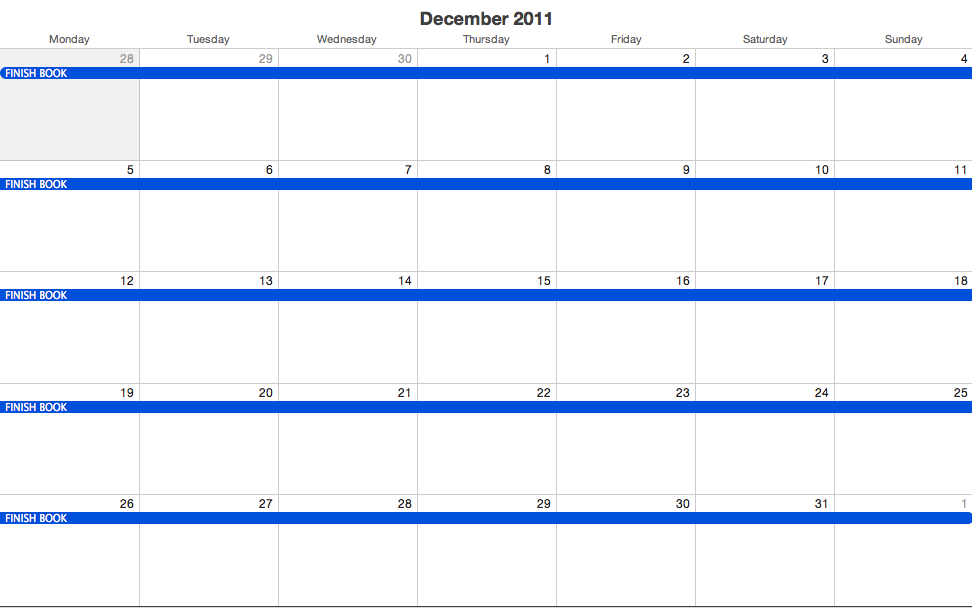
(Note to self: finish book)
So I looked at my schedule. It was a long way away, but the world doesn’t generally need productivity workshops around Christmas time. So I blocked six weeks out of my life and when the time came I flew to Sri Lanka, rented a small cabana by the beach and started writing.
It took a couple of days to get into the flow, but a couple of weeks later and 82,000 words done, I had a decent first draft (which, for any aspiring authors, probably means you’re 20% done, not the 80% I mistook it for!)
Back in the UK, I spent the spring of 2012 editing the text and involved some amazing people to make my writing better than it really is, make the words look beautiful on the page and accompany the words with images (thanks Elloa, Bernie and Allan!).
Suddenly then the “Finish Book” project ballooned into six, ten, fifteen sub-projects, all with their own beginnings, middles and ends. I talk a lot about clarity being the key to overcoming procrastination. Breaking things down into manageable chunks and getting momentum going on just a few of them really moved it all forward at breakneck speed.
I’m really proud of it and I hope you like it. I hope it inspires action and I hope it helps us spread the word about the work of Think Productive too. The interesting thing for all of us is that there’s always more to learn about our own productivity. We all have lots to teach and we all have lots to learn.
And it’s a journey we’re all on together rather than something I’ve magically figured out and am now sharing with you – although I guess spending the last three or four years being obsessed with productivity every day (as well as being productive almost every day, of course!) gives you and I both confidence that there are a good few lightbulbs hidden on those pages.
It’s been a challenge going from workshops as my communication medium (where it’s 2-way and you have the chance to have dialogue with people to clarify and emphasise) to writing it all in a book, but I’m pretty happy that what I’ve captured here are a few of the highlights, insights and golden rules from our workshops. Of course, if you like the book, the workshops take it all to another level entirely, but you’ll have to book us for your company to see what I mean.
And whilst I’m putting myself centre-stage and it was my job to be the leader that made it happen, this book is the product of many more hours’ thinking, creativity, listening and hard graft than merely my own. What I’ve learned in creating it is that followership is often harder than leadership. Because when the leader is crippled by self-doubt, scared about it not being perfect, or lost in their own procrastination, the followers have to become the leaders and the leaders need to follow. I hope this book teaches you as much reading it as it taught me conceiving it.


