

“Life is really simple, but we insist on making it complicated.” – Confucius
Sometimes as a Productivity Ninja you will seem to others like you have special powers. However, a Ninja is very different from a superhero. A Ninja is just a regular guy or girl, but with tools and skills and a very special mindset. There are no super powers and no kryptonite. Ninjas get things done in a way that seems, well magical. As a Ninja, what were once routine tasks become opportunities for fun, discovery, experimentation and the unleashing of your inner geek.
Thinking about the process of your work as well as the work itself will help you to love what you do, whatever that may be. You will gain excitement and a sense of magic from being better at doing what you were doing before; you’ll be less stressed about it; and you’ll experience a momentum in your work that you never thought possible.
Ninjas work in a unique heightened flow of relaxed productivity, brought about by hyper-awareness, calm and focus. It’s a magical experience that you won’t want to go back from. But it’s not all plain sailing either.
By seeking ultra-productivity, using unorthodox means and for a host of other more ‘human’ reasons, Ninjas are prone to screwing up once in a while. In old time management books, the time management ‘gurus’ would paint themselves as a picture of superhero perfection. They’d give you detailed planners to fill in, have you performing high fives in celebration of continuous massive achievement and leave you as the reader wondering how on earth they managed the impossible.
We’re all prone to screwing up – no matter how organised, how intelligent, or how seeming perfect we are or are trying to be. Yes, you too. We can aim for perfection and fail, or we can aim for Zen-like Calm, Ruthlessness, Weapon-Savvyness, Stealth and Camouflage, Unorthodoxy, Agility, Mindfulness and Preparedness, and succeed.
Yes, we’ll make mistakes. No, we won’t be perfect. But what we will do is increase productivity in ways you never thought possible before. It simply isn’t possible for me to make you a superhero and if you want that, there are plenty of other books out there that will promise it but won’t deliver. It’s an unrealistic dream, a fantasy never fulfilled. But it is possible that we can make you a Ninja.
This excerpt is from the book How to be a Productivty Ninja. Think Productive also offer time management training courses to help you become a true Productivity Ninja.
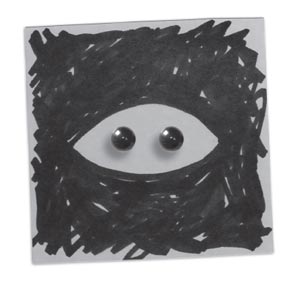
Stealth & Camoflage
This is characteristic 4 of being a Productivity Ninja….
Protecting your attention spans and keeping focussed is hard to do. This is where the Ninja needs to employ a bit of old-fashioned stealth and camouflage. If you’re in the limelight, you might get caught in the crossfire. One of the worst things you can do is make yourself always available. It’s an invitation to some of your biggest enemies: distraction and interruption. Here are a few examples:
As well as protecting our attention from others, we must recognise the need to protect our attention from ourselves. We can be our very own worst enemy. There’s a phrase in software development called ‘Going Dark’ which refers to the time when a developer is ‘in the zone’ with their programming and has subsequently stopped answering emails or responding to other communications. They can be extremely difficult to find but there’s probably some amazing productivity happening… somewhere.
If your attention and focus is likely to be impeded by unlimited access to the internet and you’re likely to be tempted by its millions of distraction possibilities (and who isn’t?!), disconnect once in a while. Yes, a productivity book is telling you to turn off the internet! If I turn off my wifi connection for two hours, I know there will be no new email arriving during that time, and that it will be annoying enough having to fiddle around with turning the connection back on to keep me from doing so.
The art of camouflage is an important skill in keeping us productive. We may be off the radar, but that certainly doesn’t mean we’re not working. Quietly hiding away is not for everyone and it’s not something you can’t do all the time. But it does focus the mind on the task at hand and avoids so many of the interruptions and distractions that we place in front of our own eyes.
Finding other people to do your work for you is a great way to get more done. The problem is that the world is pretty scarce with people who actually want to do your work for you! Hence, a bit of stealth delegation is in order. This is unorthodox for a number of reasons, but consider first that you are unlikely to be able to claim credit for your actions and also that things may turn out differently to how you had imagined.
If you’re prepared to tolerate that, it’s a great tactic. Better still, work out from your project list which of the projects you could afford to have others work on in different ways, or that you care least about. These are the ones to consider stealth delegating. Here are three common forms of stealth delegation. As a Ninja, you might well discover your own techniques, too.
Setting boundaries with meetings and your email etiquette is one of the topics we cover in our Think Productive Productivity workshops www.thinkproductive.co.uk.
“Joining a Facebook group about productivity is like buying a chair about jogging.” - Merlin Mann
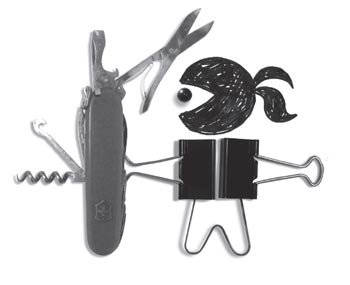
This is Characteristic 3 of the 9 Characteristics of a Productivity Ninja….
Using the right tools makes Productivity Ninjas more effective. There are a range of tools out there to help keep us on top of our game. There are two broad types of tools that the Productivity Ninja needs to have in their armoury:
Choosing what to use and when, and being aware of the capabilities of each are key to success. Tools need to give us confidence and ensure that through their productive use, we’re rarely interrupted by our own ineptitude.
As our decisions get more complex, our need for tools to assist our thinking becomes more apparent. Strategic planning processes or line management feedback situations are often where we first encounter such tools, but their value is still underestimated. There are a broad range of such thinking tools and frameworks that have been created to help make our lives easier and our decision-making better.
From Microsoft Outlook and iPhone apps to the humble stapler, there are so many ways to be organised. The trick is to get to a very good level of organisation rather than an excellent or mediocre level; this ensures that the time spent on getting organised receives the optimum payoff in increased productivity, rather than becoming a drain on our time and an unwelcome and unnecessary distraction.
Tools are there to help us get things done, but our obsession with them can occasionally become a distraction. There are some great productivity websites out there – often created or led by influential and insightful thinkers – like Merlin Mann’s http://www.43folders.com and Leo Babauta’s www.zenhabits.net, but whilst we do need to keep up with technology and innovation to the extent that it increases our productivity, we also need to be hyper-conscious that this is in itself ‘dead time’, away from the completion of our priority tasks and projects.
I worry when I hear someone talk about their productivity purely and exclusively in the context of which new iPhone productivity app they’ve just downloaded. These tools assist our thinking and organising: they don’t replace the need for it. Worse still, it’s not uncommon for people to retype all their projects and actions from one piece of software to another under the oft-mistaken premise that they’re increasing their productivity by 5% by doing this. No, that’s just a day of procrastination.
At the heart of the way of the Productivity Ninja is improving our ability to make decisions. By challenging ourselves to continually improve and innovate, the quality, quantity and speed of our decisions will increase. Remember that informed and clear decision-making is our aim. Thinking tools help boost our mental agility, but so does the right information.
Twitter and Facebook are fantastic tools for throwing out questions or issues to a group of trusted friends and colleagues: it’s so valuable getting a second, third, fourth and fifth opinion on something. It’s amazing how much time and mental energy you’ll save. But equally, don’t be afraid to think independently and draw your own conclusions when your instinct tells you to
If you liked this article, please bookmark it on del.icio.us or vote for it on Digg! Graham Allcott is the founder of Think Productive a Productivity company that specializes in time management training courses. He tweets at @grahamallcott
“Begin with the end in mind.”– Stephen Covey

This is the second in a series of posts defining the Characteristics of a Productivity Ninja….
As well as needing to make more and better decisions, we need to be choosy, processing information to sort the wheat from the chaff and the big opportunities from the even bigger ones. Ruthlessness isn’t just about how we process information, it’s also about our ability to protect our time and attention, focussing only on the things that add the greatest impact, even at the expense of other things that are ‘worth doing’.
With abundance of information such a problem, being choosy is the only way. It goes against the western, protestant work ethic culture that we’re so familiar with to decide not to do things, but that’s exactly what we must do. Being much choosier about what we say “Yes” to is an important skill – and learning to say “No” to ourselves means not biting off more than we can chew. If you do get into situations where you’ve bitten off more than you can chew (and I do this regularly,by the way!), it’s about realising that renegotiating your commitments to yourself and others is better than burning yourself out trying to meet them all.
Picture this. You’re in a meeting that you thought you were attending purely to contribute to, and the meeting discussion begins to come around to some decisions and commitments about actions people could take at the end of the
meeting. There’s a particular set of actions that you’re renowned for being good at, and just as it’s mentioned, several pairs of eyes turn and focus on you. Saying “No” to others is tricky. It requires steely resolve, a ruthless streak and some great tactics so that you come out smelling of roses.
Our attention – particularly that proactive attention when we’re most alert, in flow and on top of our game – is arguably our most precious resource. It needs to be nurtured and valued. At the same time, there are a million interruptions out there: emails, phone calls, thoughts, stress, colleagues, social media, the next big crisis, the next big thing.
We often like to be distracted because it’s the perfect excuse for procrastination and thinking less. Facebook or Twitter win over the report we’re supposed to be finishing simply because it’s easier to be in those places, having conversations, than it is to get into the difficult thinking we’re supposed to be engaged in.
Using the 80-20 rule, we can start to recognise that not all of what we do creates an equal amountof impact. 20% of what we do accounts for 80% of the impact. Often, there’s a temptation to aim for perfection. In some areas of our work, this perfection is healthy and even necessary but in other cases, it can be avoided and the impact on the final result hardly even noticed. So we need to be ruthless in our planning. What are we trying to achieve? Has someone else solved this problem before? Could we beg, borrow or steal?
I hope you enjoyed this article on increasing productivity by developing the ninja skill of ruthlessness. If you have any other time management tips, please feel free to share them below!
Subscribe to Think Productive’s free Time Management newsletters Click here to subscribe.
“The mind is for having ideas, not for holding them.” – David Allen

This is the first in a series of posts defining the Characteristics of a Productivity Ninja….
So you want to be a Productivity Ninja? The first characteristic you need to nurture is Zen-like Calm. Good decision-making comes from the ability to create the time and space to think rationally and intelligently. The Ninja realises this, remains calm in the face of adversity, and equally calm under the pressure of information overload. You might not believe this, but it is entirely possible to have a hundred and one things to do and yet still remain absolutely calm.
How do we beat stress and remain calm? I answer this question more fully in my book as well as the practical skills needed for Ninja-mastery of email, tasks, projects and meetings. Here are a few basic principles:
Be sure that you’re not forgetting important items by keeping all of your support information in a system, not in your head. Be sure that you’re not distracted and stressed by what you could be forgetting – by using a system instead of your own head as the place where information and reminders live.
You need to have trust that whatever systems you use will work. There is a danger that additional stress will be created by the uncertainty of not knowing whether your systems will help you deliver. Sticking to what you trust and trusting what you stick to are crucial. The way to foster this trust and promote the Zen-like calm you need is to regularly consider not just your work, but the process of your work too. Briefly but regularly reviewing how you work will help you to promote clearer thinking in the work itself.
Realise that you’ll never get everything done. That’s not the game anymore. Be safe in the knowledge that you’re in control, selecting the right things to do. This does not mean ‘don’t be ambitious’; it does mean that if you have a sense of ambition, you’ll probably experience some times in your life with more on your plate than you can physically do. The truth is that worry, stress and negative thought patterns are tiring and completely unproductive.
Eat porridge. Keeping fit and healthy will not only reduce stress and give your brain the focus and energy it needs to produce clearer thinking and decision making and it means you’ll look hot. It’s a win-win-win! There are hundreds of theories about why physical fitness positively impacts the brain. I discuss a few of them in Chapter 3 of the book.
“I don’t have the time to be organised,” is a common objection I hear when coaching clients towards Productivity Ninja status. But the truth is that when we experience periods of ‘flow’ – the times in our day or week when we’re most productive – the last thing we want to do is be thrown off track by being unable to find some crucial piece of information or by not having the tools we need readily available.
Usually, those people who naturally resist the idea of being organised are the very same people who experience the greatest mindset shift from getting their paperwork, projects, email inbox and everything else under control. It’s immensely calming if you do it regularly, but probably even more so if you don’t normally experience it very often. The realisation that after each battle comes a period of rest and realignment, and the strategic value of preparedness for the battles to come, are central to the Ninja philosophy.
This is an edited extract from How to be a Productivity Ninja. Read more buy the book….
 Last week was the launch of “How to be a Productivity Ninja”, a culmination of the last three years of thinking and getting things done from Graham Allcott. Adopting the mind-set of a Ninja offers very useful ways to approach your work. This week we thought we’d give you a taste of the nine characteristics of a Productivity Ninja described in the book….
Do you have a system to store the information, actions, task lists, checklists and files? What could be improved to make it easier to access? Zen like calm is an ability to remain focused and not be stressed by all the things you’re not doing.
Saying ‘no’ to as many distractions as possible. Could you afford to be more ruthless in your focus?
Knowing what tools to use, but being clear that the tools are there to save you time, not provide distractions. Do you have good communication systems in place and is it easy to track who does what?
Get out of the chaos once in a while. Are there times when people working alone, away from the limelight, might be more productive.
Challenge the status quo. Think how would Nelson Mandela make it, or how would Amazon.com make it? Take inspiration from unusual (as well as usual) places.
Have good systems to help you react and respond quickly. Are there opportunities to discuss the storm during the calm before it? Plan ahead!
Ask youself good questions and avoid stress. Are you a good listener – to yourselves and to others?
Knowing that rest, relaxation and good organisation skills are important. If you’re over-stretched, can you see light at the end of the tunnel? If not, change it!
Last but no means least, one of the loudest messages in the book is that in order to be a Productivity Ninja, you don’t have to magically become a superhero. Superheroes only exist in the movies and you’ve got real work to do, back here on planet Earth.
You might be surprised to learn that to be a productivity ninja is not like being a superhuman. Essentially we are human beings not human doings. Humans make mistakes and we shouldn’t try to be perfect.
Aiming for perfection is often the quickest way to get stuck. The important thing is to finish, not to be perfect. Celebrate your mistakes – use them for good. Adopting a Productivity Ninja mind-set is a great way to create a safe space to innovate and ultimately, to change the world!
“How to be a Productivity Ninja” is available on Amazon buy your copy today. The e-book is being sold in aid of READ International.
This is Part 1 of a series of posts describing the characteristics that will help you to become a Productivity Ninja. Look out for new posts everyday this week. How many characteristics do you relate to? Please leave your comments below…
In the summer of 2011, I sat with my regular weekly checklist, staring at a project on my Projects List:
“Finish Book”.
It was one of those projects. I’d spent the last few months telling people I was writing a book. I kind of was. I’d written about 30,000 words. I’d had some conversations with publishers that seemed pretty promising. I was secretly waiting for the call.
The call comes through. It says, “Graham, we love your idea for the book. We’re gonna pay you an advance. How does three months sound for the deadline?”. The book was important to me, but so was running a new business and I needed the excuse or the reason or the logic to drop everything and focus, just like I’d successfully done when the publishers had asked for sample chapters.
To cut a long story short, I’d spent a long time waiting for the publishers to commit. They liked the content but didn’t like the title. Yes, I know. And they were taking a LONG time to make a decision over whether they could live with the title I wanted and publish it anyway.
“Finish Book”.
So I was stuck. I started using my checklist review time to start asking myself questions to try and work out how to unstick things. What did I need here? Well, I needed a deadline that forced me to create the mental space, away from the business, to pick up the writing again; or if I didn’t need the deadline part I certainly needed lots of space to think and write and edit and think and write some more.
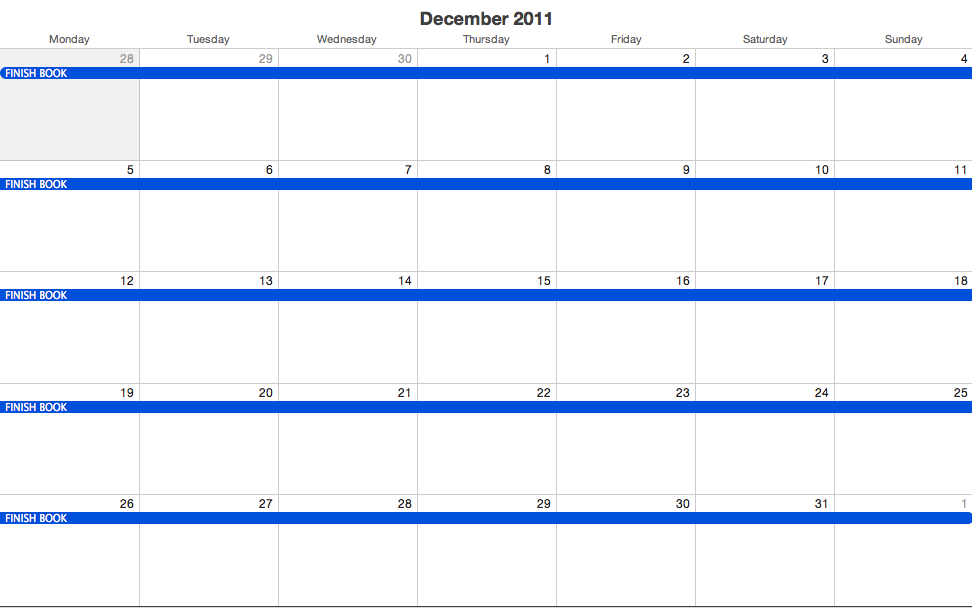
(Note to self: finish book)
So I looked at my schedule. It was a long way away, but the world doesn’t generally need productivity workshops around Christmas time. So I blocked six weeks out of my life and when the time came I flew to Sri Lanka, rented a small cabana by the beach and started writing.
It took a couple of days to get into the flow, but a couple of weeks later and 82,000 words done, I had a decent first draft (which, for any aspiring authors, probably means you’re 20% done, not the 80% I mistook it for!)
Back in the UK, I spent the spring of 2012 editing the text and involved some amazing people to make my writing better than it really is, make the words look beautiful on the page and accompany the words with images (thanks Elloa, Bernie and Allan!).
Suddenly then the “Finish Book” project ballooned into six, ten, fifteen sub-projects, all with their own beginnings, middles and ends. I talk a lot about clarity being the key to overcoming procrastination. Breaking things down into manageable chunks and getting momentum going on just a few of them really moved it all forward at breakneck speed.
I’m really proud of it and I hope you like it. I hope it inspires action and I hope it helps us spread the word about the work of Think Productive too. The interesting thing for all of us is that there’s always more to learn about our own productivity. We all have lots to teach and we all have lots to learn.
And it’s a journey we’re all on together rather than something I’ve magically figured out and am now sharing with you – although I guess spending the last three or four years being obsessed with productivity every day (as well as being productive almost every day, of course!) gives you and I both confidence that there are a good few lightbulbs hidden on those pages.
It’s been a challenge going from workshops as my communication medium (where it’s 2-way and you have the chance to have dialogue with people to clarify and emphasise) to writing it all in a book, but I’m pretty happy that what I’ve captured here are a few of the highlights, insights and golden rules from our workshops. Of course, if you like the book, the workshops take it all to another level entirely, but you’ll have to book us for your company to see what I mean.
And whilst I’m putting myself centre-stage and it was my job to be the leader that made it happen, this book is the product of many more hours’ thinking, creativity, listening and hard graft than merely my own. What I’ve learned in creating it is that followership is often harder than leadership. Because when the leader is crippled by self-doubt, scared about it not being perfect, or lost in their own procrastination, the followers have to become the leaders and the leaders need to follow. I hope this book teaches you as much reading it as it taught me conceiving it.


