
In the summer of 2011, I sat with my regular weekly checklist, staring at a project on my Projects List:
“Finish Book”.
It was one of those projects. I’d spent the last few months telling people I was writing a book. I kind of was. I’d written about 30,000 words. I’d had some conversations with publishers that seemed pretty promising. I was secretly waiting for the call.
The call comes through. It says, “Graham, we love your idea for the book. We’re gonna pay you an advance. How does three months sound for the deadline?”. The book was important to me, but so was running a new business and I needed the excuse or the reason or the logic to drop everything and focus, just like I’d successfully done when the publishers had asked for sample chapters.
To cut a long story short, I’d spent a long time waiting for the publishers to commit. They liked the content but didn’t like the title. Yes, I know. And they were taking a LONG time to make a decision over whether they could live with the title I wanted and publish it anyway.
“Finish Book”.
So I was stuck. I started using my checklist review time to start asking myself questions to try and work out how to unstick things. What did I need here? Well, I needed a deadline that forced me to create the mental space, away from the business, to pick up the writing again; or if I didn’t need the deadline part I certainly needed lots of space to think and write and edit and think and write some more.
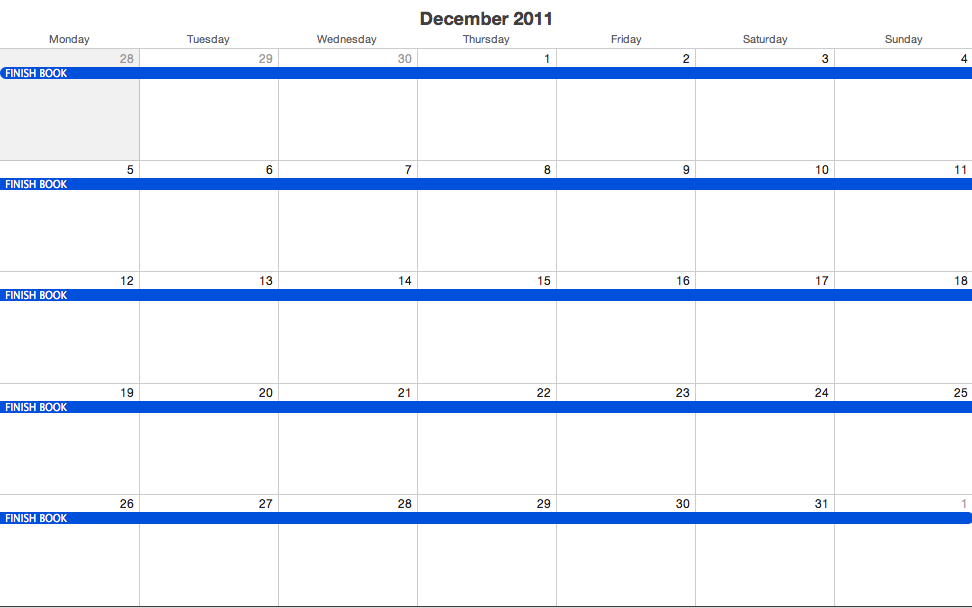
(Note to self: finish book)
So I looked at my schedule. It was a long way away, but the world doesn’t generally need productivity workshops around Christmas time. So I blocked six weeks out of my life and when the time came I flew to Sri Lanka, rented a small cabana by the beach and started writing.
It took a couple of days to get into the flow, but a couple of weeks later and 82,000 words done, I had a decent first draft (which, for any aspiring authors, probably means you’re 20% done, not the 80% I mistook it for!)
Back in the UK, I spent the spring of 2012 editing the text and involved some amazing people to make my writing better than it really is, make the words look beautiful on the page and accompany the words with images (thanks Elloa, Bernie and Allan!).
Suddenly then the “Finish Book” project ballooned into six, ten, fifteen sub-projects, all with their own beginnings, middles and ends. I talk a lot about clarity being the key to overcoming procrastination. Breaking things down into manageable chunks and getting momentum going on just a few of them really moved it all forward at breakneck speed.
I’m really proud of it and I hope you like it. I hope it inspires action and I hope it helps us spread the word about the work of Think Productive too. The interesting thing for all of us is that there’s always more to learn about our own productivity. We all have lots to teach and we all have lots to learn.
And it’s a journey we’re all on together rather than something I’ve magically figured out and am now sharing with you – although I guess spending the last three or four years being obsessed with productivity every day (as well as being productive almost every day, of course!) gives you and I both confidence that there are a good few lightbulbs hidden on those pages.
It’s been a challenge going from workshops as my communication medium (where it’s 2-way and you have the chance to have dialogue with people to clarify and emphasise) to writing it all in a book, but I’m pretty happy that what I’ve captured here are a few of the highlights, insights and golden rules from our workshops. Of course, if you like the book, the workshops take it all to another level entirely, but you’ll have to book us for your company to see what I mean.
And whilst I’m putting myself centre-stage and it was my job to be the leader that made it happen, this book is the product of many more hours’ thinking, creativity, listening and hard graft than merely my own. What I’ve learned in creating it is that followership is often harder than leadership. Because when the leader is crippled by self-doubt, scared about it not being perfect, or lost in their own procrastination, the followers have to become the leaders and the leaders need to follow. I hope this book teaches you as much reading it as it taught me conceiving it.
In 2001, I arrived in the world of work with a burning ambition to change the world. I threw myself fully and chaotically into my first ‘proper’ job, running student volunteering at the University of Birmingham. I think we did pretty well. We expanded the profile of volunteering on campus pretty enormously, went from about 300 students volunteering when I started to about 2000 three years later, and we inspired dozens of new student-led community projects, many of which have gone on to become successful charities and community enterprises in their own right.
But there was a consequence. I was working incessantly and restlessly and was in severe danger of burnout. I was in on weekends, because students were changing the world on weekends too. And when the university holidays came and my whole building closed at 5pm, I was always the last one being dragged from my computer keyboard at 5.30. My boss even phoned my now wife on her personal mobile, begging her to force me to take a day off.
Then, I discovered Stephen Covey’s book “The Seven Habits of Highly Effective People”. Strip away some of the naff American guru stuff and it’s a really useful book. I realised I needed more balance, it focussed me less on work and more on life again and I took several months out working on HIV education programmes in rural Uganda.
After I returned, I became Chief Executive of Student Volunteering England, the national charity that promoted student volunteering. I’d gone from licking envelopes in a shabby university basement office to talking about student volunteering at 10 Downing Street in just a few short years (and incidentally, I was so busy that I had to go to Downing Street wearing a second hand suit I’d bought in Uganda because I didn’t have time to go and buy a ‘proper’ one.)

After three years of giving that job my all, teetering once again on the brink of burnout in my quest to change the world, I decided I needed to change. My neglected passion for many years was music and songwriting, so I developed a freelance business so that I could fill the rest of my time pursuing my music – swapping early morning breakfast meetings for late night gigs in random parts of London. I even managed a couple of festival appearances and a CD.
Around that time, I started to give a lot more thought not just to the work itself, but the process of my work – “How could I do this more easily? What’s most important here?”. I also read David Allen’s important book “Getting Things Done” and read blog posts from Merlin Mann on 43folders.com. It was a bit of a lightbulb moment for me: we really can change the world, or achieve what we really want to achieve, without it being so hard. Relaxed productivity is actually easier than pent-up panic and frustration.
And I started to talking to people about it. A lot. In fact, I talked to people so much that they asked me to run workshops for their teams or sit with them at their desks and show them the secret sauce.
My secret was to tell them that there wasn’t any secret sauce, but doing simple things consistently and well could make all the difference. Around that time I was freelancing in charities and government departments and sensing that I wasn’t the only person who’d been struggling with these kind of issues. I’d been on time management training before, but it all seemed a little academic, tired, even insincere.

And so Think Productive was born, in 2009. It perhaps wasn’t the best idea to start a niche training company just as a large recession hit the UK and the rest of the world, but looking back I still maintain that whilst certainly risky, doing this work in such a time of economic depression is all the more important. So we did it.
We’ve grown as an organisation since then. And once again I’ve gone from stapling the training handouts and licking envelopes in the shabby spare room/cupboard of my rented flat to being featured in major websites and magazines about productivity. So this book feels like the natural next step. I look forward to an invite to Downing Street to talk productivity there too. This time, I’ll be wearing a proper suit.


